
Humans are the ultimate invasive species. What we do puts Japanese knotweed in the shade. Our footprint has wiped out entire species, from mammoths to dodos. The tricky relationship between humans and evolution could be a metaphor for the abyss which humankind stares into today. It was the subject of Humanist UK’s Darwin Day lecture at Conway Hall, a home in Central London for freethinking since 1929.
Speaker Professor Matthew Cobb outlined some of the many ways humans have impacted on planetary life. Examples of unintended consequences include the evolution of elephants with dwindling tusks, more likely to survive predation by ivory hunters.
Intended change pervades agriculture, where there has been selective breeding of plants and animals for millennia and monoculture is superseding nature’s rich genetic diversity.
Human impact accelerated from the 1970’s when genetic engineering took off. It can be a force for good. Insulin, a lifesaver for many, is now reproduced cheaply by placing its DNA code into yeast cells.
But there is a dark side. Nature quickly got around ‘miracle’ GM crops developed to be bug resistant. Mosquitoes could now be bred out of existence, but scientists hesitate, fearful of ramifications for other species in nature’s web. Then in 2018 Chinese scientist He Jiankui caused uproar when he claimed to have created the first genetically edited human babies. The prospect of cloned children is no longer the stuff of science fiction.
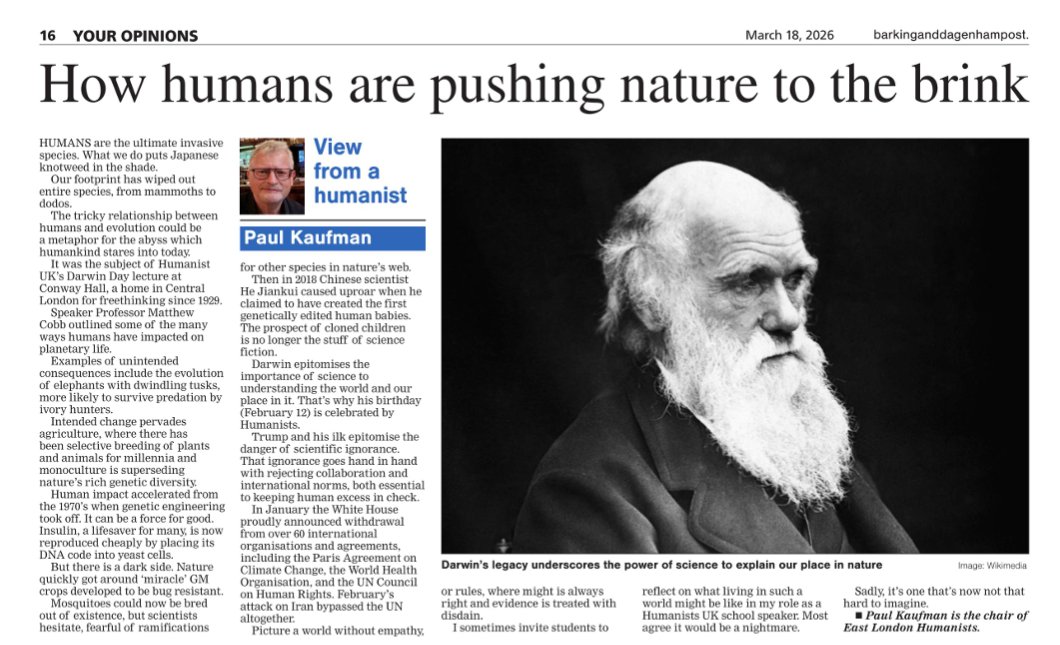
Darwin epitomises the importance of science to understanding the world and our place in it. That’s why his birthday (12 February) is celebrated by Humanists.
Trump and his ilk epitomise the danger of scientific ignorance. That ignorance goes hand in hand with rejecting collaboration and international norms, both essential to keeping human excess in check. In January the White House proudly announced withdrawal from over 60 international organisations and agreements, including the Paris Agreement on Climate Change, the World Health Organisation, and the UN Council on Human Rights. February’s attack on Iran bypassed the UN altogether.
Picture a world without empathy, or rules, where might is always right and evidence is treated with disdain. I sometimes invite students to reflect on what living in such a world might be like in my role as a Humanists UK school speaker. Most agree it would be a nightmare. Sadly, it’s one that’s now not that hard to imagine.
Paul Kaufman
Chairperson East London Humanists


